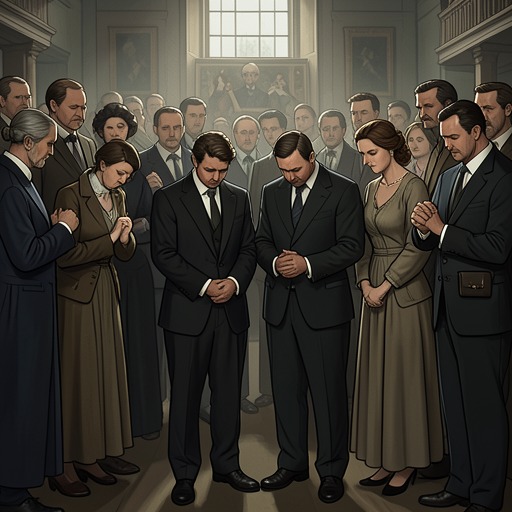
The 1960s
On Chesil BeachThe 1960s signify a future that Edward Mayhew and Florence Ponting expect to inherit, but the decade’s promised freedom arrives unevenly. At the beginning of their adult lives, political hope and a sense of generational possibility coexist with rigid sexual conventions and an inability to discuss private difficulty. By the decade’s later years, Edward’s experience has changed enough for him to reinterpret a crucial moment in their marriage, revealing the distance between the future they imagined and the freedoms that gradually became thinkable.
A Decade Claimed by the Young
For Edward and Florence, the 1960s are their first decade as adults and a chance to leave behind the condition of being young, which the novel describes as a social disadvantage. Marriage seems to promise entry into maturity. At the same time, the couple imagine a shared future in which they will choose where and how to live, decide what place Florence’s music and Edward’s work will have, and avoid becoming inwardly like other people. Their confidence makes the decade feel personally theirs as well as historically open.
Their optimism has a political dimension. They expect to vote for the first time in the coming General Election and hope for a Labour Party victory comparable to the 1945 landslide. They look toward politicians such as Gaitskell, Wilson, and Crosland as representatives of a modern country organized around equality and effective change. The contrast is generational: older hotel guests retain memories of wartime sacrifice and attachment to imperial standing, while Edward and Florence regard Britain’s diminishing international power as evidence that a different future must take shape. Their sense that youthful energy is pressing against the old order becomes entangled with the excitement of beginning married life.
Inherited Rules in Private Life
The wedding-night setting exposes the limits of that confidence. Edward and Florence are educated adults, but both are sexually inexperienced, and the surrounding culture offers them little language for discussing difficulty. Their marriage ceremony and reception have gone well; in the privacy of the hotel room, however, neither can readily speak about the intimacy they fear and anticipate. The social rules are not simply imposed by someone else. Even when alone and free to choose, they feel bound by expectations about proper adult conduct and by habits of restraint that neither has learned to question aloud.
Edward’s own preparation shows how personal anxiety takes shape within those conventions. He has refrained from solitary sexual activity for more than a week because he wants to be ready for his bride, but this effort does not give him confidence about what will happen. He has mistaken Florence’s shyness for a conventional veil over a more sensual nature, while recognizing that her reserve also makes him feel safer: his own inexperience might have been more exposed with a more demanding partner. Their courtship has proceeded through unspoken protocols, and neither has treated intimate conversation as necessary. The decade’s promise of change has not yet supplied them with a practical way to speak.
Uneven Social Change
Edward’s student years in London provide a wider measure of the sexual conventions that persist around the start of the decade. Among the women he knows at university, premarital chastity is conveyed as an expectation, and sex is understood to imply marriage. One fellow student’s marriage after a pregnancy becomes a cautionary example among his friends. In this social world, the Pill appears only as an implausible newspaper rumor, while stories of casual sex among students in other departments remain speculation rather than evidence from Edward’s own experience.
Those rumors coexist with a culture of sexual boasting that offers little genuine knowledge or intimacy. Edward’s male social circle relies on dirty jokes, uneasy claims, heavy drinking, and camaraderie; these habits do not bring the sexual freedom imagined from afar. The contrast matters because it prevents the decade from appearing as a sudden, uniform break with the past. New ideas circulate unevenly, and what Edward hears about other people’s lives does not immediately alter the expectations governing his own.
Retrospection and Transformation
Toward the end of the decade, Edward’s circumstances have changed. New fashions and freedoms accompany a series of love affairs, and he becomes more sexually experienced. Looking back, he no longer judges Florence’s proposal on their wedding night as ridiculous, insulting, or disgusting. It instead appears to him as generous and ahead of its time: an offer whose meaning he could not recognize within the more restrictive assumptions of their earlier relationship. He has never discussed that night with anyone, so the reinterpretation remains private, a measure of how far his understanding has moved without undoing what happened.
His life also diverges from the scholarly future once anticipated for him. He becomes involved in administering rock festivals, works in and later part-owns a record shop, writes for small magazines, helps start a health-food canteen, and travels in France with a woman who becomes his wife for three and a half years. He lives in Paris with her, while his earlier plans for a serious historical career fall away without a single decisive break. These changes give the decade material shape: its new possibilities alter work, relationships, and everyday life, but they do not produce a simple or settled account of freedom.
The Decade’s Double Meaning
The novel uses the 1960s both as a historical transition and as a measure of belated understanding. At the decade’s beginning, Edward and Florence imagine that modern political energy and their own adulthood will release them from inherited limits. Yet their first night as a married couple is governed by silence, anxiety, and convention. Years later, greater sexual permissiveness allows Edward to see Florence’s earlier gesture differently, but recognition arrives after their relationship has ended.
That contrast makes the decade’s change consequential without making it complete. The young couple’s optimism is not false, but it runs ahead of the language, knowledge, and social practices available to them. Edward’s later life demonstrates how quickly those conditions can shift; his memory of Florence demonstrates that a changed era cannot recover an opportunity misunderstood in the past. The 1960s thus frame both a widening of possible lives and the cost of arriving at new understanding too late.